The pyruvate dehydrogenase complex links glycolysis to the TCA cycle (also known as the Krebs cycle or the citric acid cycle). It is a large multi-enzyme complex composed of three enzymes involving five cofactors. The pyruvate dehydrogenase complex oxidizes pyruvate to generate acetyl-coA.
Introduction
This entire process takes place in the mitochondria of the cell. The mitochondria is an organelle in the cell. It is considered the "powerhouse" of the cell. Pyruvate is transported there via pyruvate translocase. Pyruvate dehydrogenase is a multi-enzyme complex that uses three enzymes:
- E1: Pyruvate dehydrogenase which uses thiamine pyrophosphate (TPP) as its prosthetic group.
- E2: Dihydrolipoyl transacetylase which uses lipoamide and coenzyme A (also known as coASH) as its prosthetic groups.
- E3: Dihydrolipoyl dehydrogenase which uses flavin adenine dinucleotide (FAD) and nicotinamide adenine dinucleotide (NAD+) as its cofactors.
Note: Prosthetic groups are molecules that are covalently bonded to an enzyme.
The net reaction of converting pyruvate into acetyl coA and CO2 is:
HTTP Status: BadRequest(400) (click for details)Callstack:
at Biological_Chemistry/Metabolism/Pyruvate_Dehydrogenase_Complex
at math.Formula
MindTouch.Dream.DreamResponseException: HTTP Status: BadRequest(400)
at MindTouch.Deki.Script.Runtime.TargetInvocation.DekiScriptRemoteInvocationTarget.InvokeMap (MindTouch.Deki.Script.DekiScriptRuntime runtime, MindTouch.Deki.Script.Expr.DekiScriptMap args) [0x00000]
at MindTouch.Deki.Script.Runtime.TargetInvocation.ADekiScriptInvocationTarget.Invoke (MindTouch.Deki.Script.DekiScriptRuntime runtime, MindTouch.Deki.Script.Expr.DekiScriptLiteral args) [0x00000]
at MindTouch.Deki.Script.DekiScriptRuntime.Invoke (MindTouch.Dream.XUri uri, MindTouch.Deki.Script.Expr.DekiScriptLiteral args, MindTouch.Deki.Script.Runtime.DekiScriptEnv env) [0x00000]
The Process
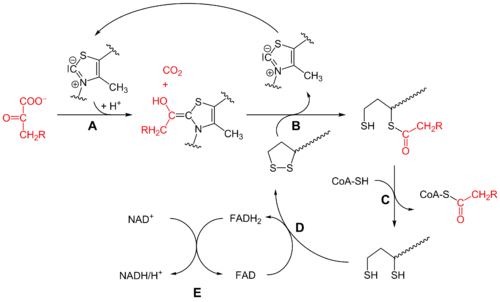
This is a five step process.
- Step A: Pyruvate is decarboxylated by pyruvate dehydrogenase with help from TPP.
- Step B: The reactive carbon (between the N and the S of the five membered ring) of the TPP is oxidized and transferred as the acetyl group to lipoamide (which is the prosthetic group of the dihydrolipoyl transacetylase). This forms hydroxyethyl-TPP. An H+ ion is required for the intermediate to give off CO2.
- Step C: E2 (dihydrolipoyl transacetylase with cofactor lipoamide) oxidizes hydroxyethyl- to acetyl- and then transfers acetyl- to CoA, forming acetyl-CoA.
- Step D: Acetyl CoA was made in the previous step. However, the process is incomplete. The E2 is still attached to the acetyl CoA molecule. So, E3 (dihydrolipoyl dehydrogenase) oxidizes the thiol groups of the dihydrolipoamide back to lipoamide.
- Step E: As a side reaction, NAD+ becomes reduced to NADH.

Figure 1: The process of the PDH. Used with permisison from Wikipedia.
References
- Zubay, Geoffrey. Biochemistry. New York: Macmillan Publishing Company, 1988.
- Boyer, Rodney. Concepts in Biochemistry. New Jersey: John Wiley & Sons, Inc, 2006.
Problems
1. How many NADH are generated as products?
2. How does this process turn pyruvate into acetyl CoA?
3. Why do we need E3?
4. Where does this process occur in the cell?
5. What is the name of the enzyme that transports the pyruvate into the PDH?
Answers
1. 2 molecules
2. Pyruvate decarboxylation
3. We need E3 to essentially "fix" the E2 after the acetyl CoA is formed. The E2 remains attached to the molecule even after acetyl CoA is formed. Therefore, the E3 must reduce the E2 and restore it to its original form.
4. The mitochondria
5. Pyruvate translocase
Contributors
- Tiffany Lui, University of California, Davis
This page viewed 14270 times
The ChemWiki has 9258 Modules.