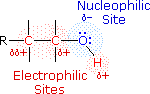
Properties of AlcoholsTable of contentsAlcohols are one of the most important molecules in organic chemistry. They can be prepared from many different types of compounds and they can be converted into many different types of compounds. Alcohols are molecules containing the hydroxy functional group (-OH) that is bonded to a carbon atom of an alkyl or substituted alkyl group. The hydroxy functional group strongly contributes to the physical properties of alcohols. Structure of AlcoholsThe stucture of an alcohol resembles that of water. With both alcohol and water, the bond angles reflect the effect of electron replusion and increasing steric bulk of the substituents on the central oxygen. The electronegativity of oxygen contributes to the unsymmetrical distribution of charge, creating a partial positive charge on the hydrogen and a partial negative charge on the oxygen. This uneven distibution of electron density in the O-H bond creates a dipole. Also, because of the high electronegativity of oxygen relative to that of carbon, the O-H bond is shorter (1.41 A for C-O vs. 1.51 A for C-C) and stronger (ΔHoO-H = 104 kcal mol-1 for C-O vs. ΔHoC-H = 98 kcal mol-1 for C-C).
Water Methanol
Hydrogen Bonding and SolubilityThe physical properties of alcohols are influenced by the hydrogen bonding ability of the -OH group. The -OH groups can hydrogen bond with one another and with other molecules.
Hydrogen Bonding of Methanol Hydrogen bonding raises the boiling point of alcohols. This is due to the combined strength of so many hydrogen bonds forming between oxygen atoms of one alcohol molecule and the hydroxy H atoms of another. The longer the carbon chain in an alcohol is, the lower the solubility in polar solvents and the higher the solubility in nonpolar solvents.
This table shows that alcohols (in red) have higher boiling points and greater solubility in H2O than haloalkanes and alkanes with the same number of carbons. It also shows that the boiling point of alcohols increase with the number of carbon atoms. References
Outside LinksProblemsArrange according to increasing boiling point. (start with lowest boiling point) 1. CH4, CH3OH, CH3CH3 2. CH3CH2Cl, CH3CH2CH2OH, CH3CH2CH3 3. CH3CH2OH, CH3CH2Cl, CH4 Arrange according to increasing solubility (start with lowest solubility) 4. CH4, CH3OH, CH3CH3 5. CH4, CH3CH2Cl, CH3CH2OH, 6. CH3CH2Cl, CH3CH2CH2OH, CH3CH2CH3 Answers1. CH4, CH3CH3, CH3OH 2. CH3CH2CH3, CH3CH2Cl, CH3CH2CH2OH 3. CH3CH2Cl, CH4, CH3CH2OH 4. CH3CH3, CH4, CH3OH 5. CH3CH2Cl, CH4, CH3CH2OH, 6. CH3CH2Cl, CH3CH2CH3, CH3CH2CH2OH Contributors
This page viewed 45420 times
You must login to post a comment.
|
|||||||||||||||||||||||||||||||||||||||||||||||||||||||||||||||||||||||||||||||||||||||||||||||