

Atomic Mass
- Page ID
- 1321
Mass is a basic physical property of matter. The mass of an atom or a molecule is referred to as the atomic mass. The atomic mass is used to find the average mass of elements and molecules and to solve stoichiometry problems.
Introduction
In chemistry, there are many different concepts of mass. It is often assumed that atomic mass is the mass of an atom indicated in unified atomic mass units (u). However, the book Quantities, Units and Symbols in Physical Chemistry published by the IUPAC clearly states:
The name "atomic mass" is used for historical reasons, and originates from the fact that chemistry was the first science to investigate the same physical objects on macroscopic and microscopic levels. In addition, the situation is rendered more complicated by the isotopic distribution. On the macroscopic level, most mass measurements of pure substances refer to a mixture of isotopes. This means that from a physical stand point, these mixtures are not pure. For example, the macroscopic mass of oxygen (O2) does not correspond to the microscopic mass of O2. The former usually implies a certain isotopic distribution, whereas the latter usually refers to the most common isotope (16O2). Note that the former is now often referred to as the "molecular weight" or "atomic weight".
| name in chemistry | physical meaning | symbol | units |
|---|---|---|---|
| atomic mass | mass on microscopic scale | m, ma | Da, u, kg, g |
| molecular mass | mass of a molecule | m | Da, u, kg, g |
| isotopic mass | mass of a specific isotope | Da, u, kg, g | |
| mass of entity | mass of a chemical formula | m, mf | Da, u, kg, g |
| average mass | average mass of a isotopic distribution | m | Da, u, kg, g |
| molar mass | average mass per mol | M = m/n | kg/mol or g/mol |
| atomic weight | average mass of an element | Ar = m / mu | unitless |
| molecular weight | average mass of a molecule | Mr = m / mu | unitless |
| relative atomic mass | ratio of mass m and and the atomic mass constant mu | Ar = m / mu | unitless |
| atomic mass constant | mu = m(12C)/12 | mu = 1 Da = 1 u | Da, u, kg, g |
| relative molecular mass | ratio of mass m of a molecule and and the atomic mass constant mu | Mr = m / mu | unitless |
| relative molar mass | ? | ? | ? |
| mass number | nucleon number | A | nucleons, or unitless |
| integer mass | nucleon number * Da | m | Da, u |
| nominal mass | integer mass of molecule consisting of most abundant isotopes | m | Da, u |
| exact mass | mass of molecule calculated from the mass of its isotopes (in contrast of measured ba a mass spectrometer) | Da, u, kg, g | |
| accurate mass | mass (not normal mass) | Da, u, kg, g |
These concepts are further explained below.
Average Mass
Isotopes are atoms with the same atomic number, but different mass numbers. A different mass size is due to the difference in the number of neutrons that an atom contains. Although mass numbers are whole numbers, the actual masses of individual atoms are never whole numbers (except for carbon-12, by definition). This explains how lithium can have an atomic mass of 6.941 Da. The atomic masses on the periodic table take these isotopes into account, weighing them based on their abundance in nature; more weight is given to the isotopes that occur most frequently in nature. Average mass of the element E is defined as:
\[ m(E) = \sum_{n=1} m(I_n) \times p(I_n) \]
where ∑ represents a n-times summation over all isotopes \(I_n\) of element E, and p(I) represents the relative abundance of the isotope I.
Find the average atomic mass of boron using the Table 1 below:
Mass and abundance of Boron isotopes
| n | isotope In | mass m (Da) | isotopic abundance p | |
|---|---|---|---|---|
| 1 | 10B | 10.013 | 0.199 | |
| 2 | 11B | 11.009 | 0.801 |
Solution
The average mass of Boron is:
\[ m(B) = (10.013\ Da)(0.199) + (11.009\ Da)(0.801) = 1.99\ Da + 8.82\ Da = 10.81\ Da \]
Relative Mass
Traditionally it was common practice in chemistry to avoid using any units when indicating atomic masses (e.g. masses on microscopic scale). Even today, it is common to hear a chemist say, "12C has exactly mass 12". However, because mass is not a dimensionless quantity, it is clear that a mass indication needs a unit. Chemists have tried to rationalize the omission of a unit; the result is the concept of relative mass, which strictly speaking is not even a mass but a ratio of two masses. Rather than using a unit, these chemists claim to indicate the ratio of the mass they want to indicate and the atomic mass constant mu which is defined analogous to the unit they want to avoid. Hence the relative atomic mass of the mass m is defined as:
\[A_r = \dfrac{m}{m_u} \]
The quantity is now dimensionless. As this unit is confusing and against the standards of modern metrology, the use of relative mass is discouraged.
Molecular Weight, Atomic Weight, Weight vs. Mass
Until recently, the concept of mass was not clearly distinguished from the concept of weight. In colloquial language this is still the case. Many people indicate their "weight" when they actually mean their mass. Mass is a fundamental property of objects, whereas weight is a force. Weight is the force F exerted on a mass m by a gravitational field. The exact definition of the weight is controversial. The weight of a person is different on ground than on a plane. Strictly speaking, weight even changes with location on earth.
When discussing atoms and molecules, the mass of a molecule is often referred to as the "molecular weight". There is no univerally-accepted definition of this term; however, mosts chemists agree that it means an average mass, and many consider it dimensionless. This would make "molecular weight" a synonym to "average relative mass".
Integer Mass
Because the proton and the neutron have similar mass, and the electron has a very small mass compared to the former, most molecules have a mass that is close to an integer value when measured in daltons. Therefore it is quite common to only indicate the integer mass of molecules. Integer mass is only meaningful when using dalton (or u) units.
Accurate Mass
Many mass spectrometers can determine the mass of a molecule with accuracy exceeding that of the integer mass. This measurement is therefore called the accurate mass of the molecule. Isotopes (and hence molecules) have atomic masses that are not integer masses due to a mass defect caused by binding energy in the nucleus.
Units
The atomic mass is usually measured in the units unified atomic mass unit (u), or dalton (Da). Both units are derived from the carbon-12 isotope, as 12 u is the exact atomic mass of that isotope. So 1 u is 1/12 of the mass of a carbon-12 isotope:
1 u = 1 Da = m(12C)/12
The first scientists to measure atomic mass were John Dalton (between 1803 and 1805) and Jons Jacoband Berzelius (between 1808 and 1826). Early atomic mass theory was proposed by the English chemist William Prout in a series of published papers in 1815 and 1816. Known was Prout's Law, Prout suggested that the known elements had atomic weights that were whole number multiples of the atomic mass of hydrogen. Berzelius demonstrated that this is not always the case by showing that chlorine (Cl) has a mass of 35.45, which is not a whole number multiple of hydrogen's mass.
Some chemists use the atomic mass unit (amu). The amu was defined differently by physicists and by chemists:
- Physics: 1 amu = m(16O)/16
- Chemistry: 1 amu = m(O)/16
Chemists used oxygen in the naturally occurring isotopic distribution as the reference. Because the isotopic distribution in nature can change, this definition is a moving target. Therefore, both communities agreed to the compromise of using m(12C)/12 as the new unit, naming it the "unified atomic mass unit" (u). Hence, the amu is no longer in use; those who still use it do so with the definition of the u in mind. For this reason, the dalton (Da) is increasingly recommended as the accurate mass unit.
Neither u nor Da are SI units, but both are recognized by the SI.
Molar Mass
The molar mass is the mass of one mole of substance, whether the substance is an element or a compound. A mole of substance is equal to Avogadro's number (6.023×10²³) of that substance. The molar mass has units of g/mol or kg/mol. When using the unit g/mol, the numerical value of the molar mass of a molecule is the same as its average mass in daltons:
- Average mass of C: 12.011 Da
- Molar mass of C: 12.011 g/mol
This allows for a smooth transition from the microscopic world, where mass is measured in daltons, to the macroscopic world, where mass is measured in kilograms.
What is the molar mass of phenol, C6H5OH?
Average mass m = 6 × 12.011 Da + 6 × 1.008 Da + 1 × 15.999 Da = 94.113 Da
Molar mass = 94.113 g/mol = 0.094113 kg/mo
Measuring Masses in the Atomic Scale
Masses of atoms and molecules are measured by mass spectrometry. Mass spectrometry is a technique that measures the mass-to-charge ratio (m/q) of ions. It requires that all molecules and atoms to be measured be ionized. The ions are then separated in a mass analyzer according to their mass-to-charge ratio. The charge of the measured ion can then be determined, because it is a multiple of the elementary charge. The the ion's mass can be deduced. The average masses indicated in the periodic table are then calculated using the isotopic abundances, as explained above.
The masses of all isotopes have been measured with very high accuracy. Therefore, it is much simpler and more accurate to calculate the mass of a molecule of interest as a sum of its isotopes than measuring it with a commercial mass spectrometer.
Note that the same is not true on the nucleon scale. The mass of an isotope cannot be calculated accurately as the sum of its particles (given in the table below); this would ignore the mass defect caused by the binding energy of the nucleons, which is significant.
| Particle | SI (kg) | Atomic (Da) | Mass Number A |
|---|---|---|---|
| Proton | 1.6726×10⁻²⁷ | 1.0073 | 1 |
| Neutron | 1.6749×10⁻²⁷ | 1.0087 | 1 |
| Electron | 9.1094×10⁻³¹ | 0.00054858 | 0 |
As shown in Table 2, the mass of an electron is relatively small; it contributes less than 1/1000 to the overall mass of the atom.
Where to Find Atomic Mass
The atomic mass found on the Periodic Table (below the element's name) is the average atomic mass. For example, for Lithium:
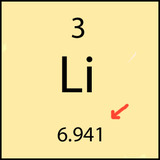
The red arrow indicates the atomic mass of lithium. As shown in Table 2 above and mathematically explained below, the masses of a protons and neutrons are about 1u. This, however, does not explain why lithium has an atomic mass of 6.941 Da where 6 Da is expected. This is true for all elements on the periodic table. The atomic mass for lithium is actually the average atomic mass of its isotopes. This is discussed further in the next section.
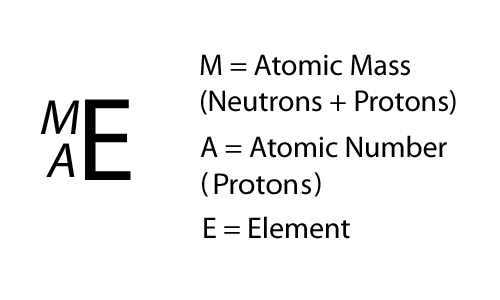
One particularly useful way of writing an isotope is as follows:
Applications
Applications Include:
- Average Molecular Mass
- Stoichiometry
Note: One particularly important relationship is illustrated by the fact that an atomic mass unit is equal to 1.66 × 10⁻²⁴ g. This is the reciprocal of Avogadro's constant, and it is no coincidence:
\[\dfrac{\rm Atomic~Mass~(g)}{1 {\rm g}} \times \dfrac{1 {\rm mol}}{6.022 \times 10^{23}} = \dfrac{\rm Mass~(g)}{1 {\rm atom}}\]
Because a mol can also be expressed as gram × atoms,
\[1\ u = \frac{M_u\ (molar\ mass\ unit)}{N_A\ (Avogadro's\ Number)} = 1\ \frac{g}{mol\ N_A} \]
1u = Mu(molar mass unit)/NA(Avogadro's Number)=1g/mol/NA
NA known as Avogadro's number (Avogadro's constant) is equal to 6.023×10²³ atoms.
Atomic mass is particularly important when dealing with stoichiometry.
Practice Problems
- What is the molecular mass of radium bicarbonate, Ra(HCO3)2?
- List the following, from least to greatest, in terms of their number of neutrons, and then atomic mass: 14N, 42Cl, 25Na, 10Be
- A new element, Zenium, has 3 isotopes, 59Ze, 61Ze, and 67Ze, with abundances of 62%, 27%, and 11% respectively. What is the atomic mass of Zenium?
- An isotope with a mass number of 55 has 5 more neutrons than protons. What element is it?
- How much mass does 3.71 moles of Fluorine have?
- How many grams are there in 4.3 × 10²² molecules of POCl3?
- How many moles are there in 23 grams of sodium carbonate?
Solutions
a) Molecular mass of Ra(HCO3)2
= 226 + 2(1.01 u + 12.01 u + (16.00 u)(3)) = 348 u or g/mol
b) Number of neutrons: 10Be, 14N, 25Na, 42Cl
Atomic Mass: 10Be, 14N, 25Na, 42Cl
Note: It is the same increasing order for both number of neutrons and atomic mass because more neutrons means more mass.
c) Atomic mass of Zenium:
(59 u)(0.62) + (61 u)(0.27) + (67 u)(0.11)
= 37 u + 16 u + 7.4 u
= 60.4 u or g/mol
d) Mn
e) (3.71 moles F2)(19 × 2 g/mol F2)
= (3.71 mol F2)(38 g/mol F2)
= 140 g F2
f) (4.3 × 10²² molecules POCI3)(1 mol/6.022 × 1023 molecules POCI3)(30.97 + 16.00 + 35.45 x 3 g/mol POCI3)
= (4.3 × 10²² molecules POCI3)(mol/6.022 × 1023 molecules POCI3)(153.32 g/mol POCI3)
= 11 g POCI3
g) (23 g Na2CO3)(1 mol/22.99 × 2 + 12.01 + 16.00 × 3 g Na2CO3)
= (23 g Na2CO3)(1 mol/105.99 g Na2CO3)
= (0.22 mol Na2CO3)
References
- Petrucci, Ralph, William Harwood, Geoffrey Herring, and Jeffry Madura. General Chemistry. 9th ed. Upper Saddle River, New Jersey: Pearson Prentice Hall, 2007
- Clifford C. Houk, Richard Post. Chemistry Concepts and Problems, a Self-Teaching Guide. 2nd ed. New York : Wiley, 1996.
- David R. Lide. CRC Handbook of Chemistry and Physics. 87th ed. New York: CRC Press, 2006.
- Loss, R.D., Report of the IUPAC Commission on Atomic Weights and Isotopic Abundances, Chemistry International, 23, 179, 2001.
- Mascetta, Joseph A. Chemistry The Easy Way. 3rd ed. New York: Barron's Educational Series, 1996.
Contributors and Attributions
- Gunitika Dandona (UCD)