

7.4: Smog
- Page ID
- 1384
Smog is a common form of air pollution found mainly in urban areas and large population centers. The term refers to any type of atmospheric pollution—regardless of source, composition, or concentration—that creates a significant reduction in atmospheric visibility. Smog encompasses a broad category of air pollutants created through a multitude of processes that relate specifically to the atmospheric conditions of the formation region. In the early 1900s, London was plagued by a particular type of smog that resulted from a combination of dense fog and soot from coal combustion. In modern times, the Los Angeles Basin is often associated with dense photochemical smog, produced through a combination of vehicle exhaust and sunlight. These are two of many examples of pollution classified as smog, but they are in no way chemically related. Smog refers to a diverse category of air pollutants with varying chemical composition; however, all types of smog form a visible haze that reduces atmospheric visibility.
Introduction
The term smog was first coined in 1905 in a paper by Dr. Henry Antoine Des Voeux to describe the combination of smoke and fog that had been plaguing London during that time. London has since enacted strict air pollution regulations which have drastically reduced incidents of smog in that region; however, London-type smog is still a major problem in areas of the world that burn large quantities of coal for heat. In the United States, smog is most typically associated with the Los Angeles Basin of Southern California and its photochemical smog. In Los Angeles, a combination of orographic features, ample sunlight, and a dense population combine to form some of the worst air quality in the United States.


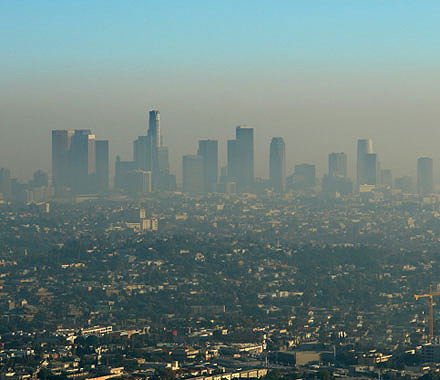
Photochemical Smog
Photochemical smog, as commonly seen in the Los Angeles Basin, is mainly composed of ozone and nitrogen dioxide. During the formation of ozone, nitrogen dioxide from vehicle exhaust is photolyzed by incoming solar radiation to produce nitrogen oxide and an unpaired oxygen atom. The lone oxygen atom then combines with an oxygen molecule to produce ozone. Under normal conditions, the majority of ozone molecules oxidize nitrogen oxide back into nitrogen dioxide, creating a virtual cycle that leads to only a very slight build up of ozone near ground level. However, when volatile organic compounds (VOCs) are present in the atmosphere, the equation changes entirely. Highly reactive VOCs oxidize nitrogen oxide into nitrogen dioxide without breaking down any ozone molecules in the process. This leads to a proliferation of ozone near ground level and dense smog formation. Although photochemical smog in the United States is mainly associated with the Los Angeles Basin, photochemical smog episodes have been reported in Denver, Philadelphia and New York.
Composition of Photochemical Smog
The following substances are identified in photochemical smog:
1. Nitrogen Dioxide (\(NO_2\)) from vehicle exhaust, is photolyzed by ultraviolet (UV) radiation (\(h\nu\)) from the sun and decomposes into Nitrogen Oxide (\(NO\) and an oxygen radical:
\[NO_2 + h\nu \rightarrow NO + O^. \label{1} \]
2. The oxygen radical then reacts with an atmospheric oxygen molecule to create ozone, O3:
\[O^. + O_2 \rightarrow O_3 \label{2} \]
3. Under normal conditions, O3 reacts with NO, to produce NO2 and an oxygen molecule:
\[O_3 + NO \rightarrow O_2 + NO_2 \label{3} \]
This is a continual cycle that leads only to a temporary increase in net ozone production. To create photochemical smog on the scale observed in Los Angeles, the process must include Volatile organic compounds (VOC's).
4. VOC's react with hydroxide in the atmosphere to create water and a reactive VOC molecule:
\[RH + OH^. \rightarrow R^. + H_2O \label{4} \]
5. The reactive VOC can then bind with an oxygen molecule to create an oxidized VOC:
\[R^. + O_2 \rightarrow RO_2 \label{5} \]
6. The oxidized VOC can now bond with the nitrogen oxide produced in the earlier set of equations to form nitrogen dioxide and a reactive VOC molecule:
\[RO_2+ NO \rightarrow RO-. + NO_2 \label{6} \]
In the second set of equations, it is apparent that nitrogen oxide, produced in equation 1, is oxidized in equation 6 without the destruction of any ozone. This means that in the presence of VOCs, equation 3 is essentially eliminated, leading to a large and rapid build up in the photochemical smog in the lower atmosphere.
Figure 1, courtesy of the EPA, depicts concentrations and constituents of photochemical smog throughout the course of an average work day. In the morning, NO and VOC concentrations are high, as people fill their cars with gas and drive to work. By midmorning , VOC's begin to oxidize NO into NO2, thus reducing their respective concentrations. At midday, NO2 concentrations peak just before solar radiation becomes intense enough to photolyze the NO2 bond, releasing an oxygen atom that quickly gets converted into O3. By late afternoon, peak concentrations of photochemical smog are present.
Controlling Photochemical Smog
Every new vehicle sold in the United States must include a catalytic converter to reduce photochemical emissions. Catalytic converters force CO and incompletely combusted hydrocarbons to react with a metal catalyst, typically platinum, to produce CO2 and H2O. Additionally, catalytic converters reduce nitrogen oxides from exhaust gases into O2 and N2, eliminating the cycle of ozone formation. Many scientists have suggested that pumping gas at night could reduce photochemical ozone formation by limiting the amount of exposure VOCs have with sunlight.
London Smog
London-type smog is mainly a product of burning large amounts of high sulfur coal. Clean air laws passed in 1956 have greatly reduced smog formation in the United Kingdom; however, in other parts of the world London-type smog is still very prevalent. The main constituent of London-type smog is soot; however, these smogs also contain large quantities of fly ash, sulfur dioxide, sodium chloride and calcium sulfate particles. If concentrations are high enough, sulfur dioxide can react with atmospheric hydroxide to produce sulfuric acid, which will precipitate as acid rain.
\[SO_2 + OH^. \rightarrow HOSO_2 \label{1} \]
\[HOSO_2 + O_2 \rightarrow HO_2 + SO_3 \label{2} \]
\[SO_3 + H_2O \rightarrow H_2SO_4 \label{3} \]
Health Hazards
Because ozone is highly reactive, it has the ability to oxidize and destroy lung tissue. Short term exposures to elevated levels of ozone (above .75 ppm) have been linked to a host of respiratory irritations including coughing, wheezing, substernal soreness, pharyngitis, and dyspnea. Prolonged exposure to the molecule has been proven to cause a permanent reduction in lung function, as well as elevate the risk of developing asthma. Sulfur dioxide is a common component of London smog. Epidemiological studies have linked short term sulfur dioxide exposure to respiratory irritations including coughing, wheezing, and pharyngitis.
References
- Miller, Jr., George Tyler (2002). Living in the Environment: Principles, Connections, and Solutions (12th Edition). Belmont: The Thomson Corporation. pp. 423.
- Petrucci, Ralph H., William S. Harwood, and Geoff E. Herring. General Chemistry : Principles and Modern Applications. 9th ed. Upper Saddle River: Prentice Hall PTR, 2006.
- Rodricks, Joseph V. Calculated Risks : The Toxicity and Human Health Risks of Chemicals in Our Environment. 2nd ed. New York: Cambridge UP, 2007.
- D.V. Bates, G.M. Bell, C.D. Burnham, et al. Short term effects of ozone on the lung. Journal of Applied Physiology. 32. 176-181. (1976).
- Godish, Thad. Air Quality. 4th ed. Florida: CRC Press LLC, 2004.
- E.T. Wilkens. Air Pollution and the London Fog of 1952. Journal of the Royal Sanitary Institute. 74. 1-22. (1956).
- Amey, Ralph L. "Atmospheric smog analysis in a balloon using FTIR spectroscopy: A novel experiment for the introductory laboratory (MODLAB)." J. Chem. Educ. 1992, 69, A148.
- Harvey, Erica; Sweeney, Robert. " Modeling Stratospheric Ozone Kinetics, Part I: The Chapman Cycle: OzoneModelingPartI.mcd. " J. Chem. Educ. 1999 76 1309.
- Harvey, Erica; Sweeney, Robert. " Modeling Stratospheric Ozone Kinetics, Part II: Addition of Hydrogen, Nitrogen and Chlorine: OzoneModelingPartII.mcd ." J. Chem. Educ. 1999 76 1310.
- Pirjola, Liisa. " Local Atmospheric Chemistry and Ozone Model (LACOM) ." J. Chem. Educ. 2000 77 1650.
- Rockwell, Dean M.; Hansen, Tony. "Inventory Control: Sampling and Analyzing Air Pollution: An Apparatus Suitable for Use in Schools." J. Chem. Educ. 1994, 71, 318.
- Sivade, A.; Begel, M.; Chastrette, M.; Cros, D.; Jourdan, G. "Chemistry Environment and Pollution: As Viewed by Students and Teachers." J. Chem. Educ. 1994, 71, 573.
- Williams, Kathryn R. " Refrigeration--From Ice Man to Ozone Hole ." J. Chem. Educ. 2000 77 1540.
- D.V. Bates, G.M. Bell, C.D. Burnham, M. Hazucha, J. Mantha, L.D. Pengelly, and F Sliverman. "Short term effects of ozone on the lung." J Appl Physiol 32: 176-181, 1976.
Problems
- True or False: Reducing NO emissions will always reduce the amount of photochemical smog that can be produced ?
- False; from equation 3, listed above, NO reacts with O3to produce NO2 and O2. Therefore, reducing NO emissions can actually increase the amount of photochemical smog in the atmosphere
2. List three factors that make the Los Angeles Basin an ideal place for photochemical smog formation.
- Los Angeles is located in an arid environment so sunlight is almost always intense enough to photolyze NO2 into NO + O.
- Los Angeles sits in a geographic bowl, surrounded by mountain ranges so photochemical smog has a tendency to be trapped directly over the city
- Los Angeles has a very dense population with millions of cars on the road every day emitting vast quantities of NOx and VOC's
3. How can pumping your gas at night reduce photochemical ozone formation?
- Pumping gas releases lots of VOC's into the atmosphere, If these VOC's are released at night, NO concentrations are low because there is no sunlight to photolyze the NO2 bond. By morning, the VOC's will likely have broken down into a less reactive compound.
4. True or False: Photochemical smog is created from a combination of soot, fly ash, and sulfur dioxide.
- False, London smog is created from a combination of soot, fly ash, and sulfur dioxide.
5. Why is it not a good idea to breath ozone?
- Ozone is a highly oxidative chemical; when ozone comes in contact with lung tissue it can oxidize and destroy it.