

Heat of Reaction
- Page ID
- 1937
The Heat of Reaction (also known and Enthalpy of Reaction) is the change in the enthalpy of a chemical reaction that occurs at a constant pressure. It is a thermodynamic unit of measurement useful for calculating the amount of energy per mole either released or produced in a reaction. Since enthalpy is derived from pressure, volume, and internal energy, all of which are state functions, enthalpy is also a state function.
Introduction
\(ΔH\), or the change in enthalpy arose as a unit of measurement meant to calculate the change in energy of a system when it became too difficult to find the ΔU, or change in the internal energy of a system, by simultaneously measure the amount of heat and work exchanged. Given a constant pressure, the change in enthalpy can be measured as
\[ΔH=q\]
See section on enthalpy for a more detailed explanation.
The notation ΔHº or ΔHºrxn then arises to explain the precise temperature and pressure of the heat of reaction ΔH. The standard enthalpy of reaction is symbolized by ΔHº or ΔHºrxn and can take on both positive and negative values. The units for ΔHº are kiloJoules per mole, or kj/mol.
ΔH and ΔHºrxn
- Δ = represents the change in the enthalpy; (ΔHproducts -ΔHreactants)
- a positive value indicates the products have greater enthalpy, or that it is an endothermic reaction (heat is required)
- a negative value indicates the reactants have greater enthalpy, or that it is an exothermic reaction (heat is produced)
- º = signifies that the reaction is a standard enthalpy change, and occurs at a preset pressure/temperature
- rxn = denotes that this change is the enthalpy of reaction
The Standard State: The standard state of a solid or liquid is the pure substance at a pressure of 1 bar ( 105 Pa) and at a relevant temperature.
The ΔHºrxn is the standard heat of reaction or standard enthalpy of a reaction, and like ΔH also measures the enthalpy of a reaction. However, ΔHºrxn takes place under "standard" conditions, meaning that the reaction takes place at 25º C and 1 atm. The benefit of a measuring ΔH under standard conditions lies in the ability to relate one value of ΔHº to another, since they occur under the same conditions.
How to Calculate ΔH Experimentally
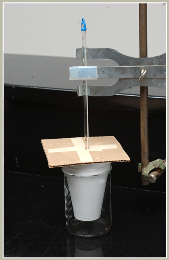
Enthalpy can be measured experimentally through the use of a calorimeter. A calorimeter is an isolated system which has a constant pressure, so ΔH=q=cpsp x m x (ΔT)
How to calculate ΔH Numerically
To calculate the standard enthalpy of reaction the standard enthalpy of formation must be utilized. Another, more detailed, form of the standard enthalpy of reaction includes the use of the standard enthalpy of formation ΔHºf:
\[ ΔH^\ominus = \sum \Delta v_p \Delta H^\ominus_f\;(products) - \sum \Delta v_r \Delta H^\ominus_f\; (reactants)\]
with
- vp= stoichiometric coefficient of the product from the balanced reaction
- vr= stoichiometric coefficient of the reactants from the balanced reaction
- ΔHºf= standard enthalpy of formation for the reactants or the products
Since enthalpy is a state function, the heat of reaction depends only on the final and initial states, not on the path that the reaction takes. For example, the reaction \( A \rightarrow B\) goes through intermediate steps (i.e. \(C \rightarrow D\)), but A and B remain intact.
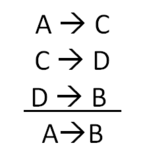
Therefore, one can measure the enthalpy of reaction as the sum of the ΔH of the three reactions by applying Hess' Law.
Since the ΔHº represents the total energy exchange in the reaction this value can be either positive or negative.
- A positive ΔHº value represents an addition of energy from the reaction (and from the surroundings), resulting in an endothermic reaction.
- A negative value for ΔHº represents a removal of energy from the reaction (and into the surroundings) and so the reaction is exothermic.
Calculate the enthalpy change for the combustion of acetylene (\(\ce{C2H2}\))
Solution
1) The first step is to make sure that the equation is balanced and correct. Remember, the combustion of a hydrocarbon requires oxygen and results in the production of carbon dioxide and water.
\[\ce{2C2H2(g) + 5O2(g) -> 4CO2(g) + 2H2O(g)}\]
2) Next, locate a table of Standard Enthalpies of Formation to look up the values for the components of the reaction (Table 7.2, Petrucci Text)
3) First find the enthalpies of the products:
ΔHºf CO2 = -393.5 kJ/mole
Multiply this value by the stoichiometric coefficient, which in this case is equal to 4 mole.
vpΔHºf CO2 = 4 mol (-393.5 kJ/mole)
= -1574 kJ
ΔHºf H2O = -241.8 kJ/mole
The stoichiometric coefficient of this compound is equal to 2 mole. So,
vpΔHºf H2O = 2 mol ( -241.8 kJ/mole)
= -483.6 kJ
Now add these two values in order to get the sum of the products
Sum of products (Σ vpΔHºf(products)) = (-1574 kJ) + (-483.6 kJ) = -2057.6 kJ
Now, find the enthalpies of the reactants:
ΔHºf C2H2 = +227 kJ/mole
Multiply this value by the stoichiometric coefficient, which in this case is equal to 2 mole.
vpΔHºf C2H2 = 2 mol (+227 kJ/mole)
= +454 kJ
ΔHºf O2 = 0.00 kJ/mole
The stoichiometric coefficient of this compound is equal to 5 mole. So,
vpΔHºf O2 = 5 mol ( 0.00 kJ/mole)
= 0.00 kJ
Add these two values in order to get the sum of the reactants
Sum of reactants (Δ vrΔHºf(reactants)) = (+454 kJ) + (0.00 kJ) = +454 kJ
The sum of the reactants and products can now be inserted into the formula:
ΔHº = Δ vpΔHºf(products) - ? vrΔHºf(reactants)
= -2057.6 kJ - +454 kJ
= -2511.6 kJ
Practice Problems
- Calculate ΔH if a piece of metal with a specific heat of .98 kJ·kg−1·K−1 and a mass of 2 kg is heated from 22oC to 28oC.
- If a calorimeter's ΔH is +2001 Joules, how much heat did the substance inside the cup lose?
- Calculate the ΔH of the following reaction: CO2 (g) + H2O (g) --> H2CO3 (g) if the standard values of ΔHf are as follows: CO2 (g): -393.509 KJ /mol, H2O (g) : -241.83 KJ/mol, and H2CO3(g) : -275.2 KJ/mol.
- Calculate ΔH if a piece of aluminum with a specific heat of .9 kJ·kg−1·K−1 and a mass of 1.6 kg is heated from 286oK to 299oK.
- If the calculated value of ΔH is positive, does that correspond to an endothermic reaction or an exothermic reaction?
Solutions
- ΔH=q=cpsp x m x (ΔT) = (.98) x (2) x (+6o) = 11.76 kJ
- Since the heat gained by the calorimeter is equal to the heat lost by the system, then the substance inside must have lost the negative of +2001 J, which is -2001 J.
- ΔHº = ∑ΔvpΔHºf(products) - ∑Δ vrΔHºf(reactants) so this means that you add up the sum of the ΔH's of the products and subtract away the ΔH of the products: (-275.2kJ) - (-393.509kJ + -241.83kJ) = (-275.2) - (-635.339) = +360.139 kJ.
- ΔH=q=cpsp x m x (ΔT) = (.9) x (1.6) x (13) = 18.72 kJ
- Endothermic, since a positive value indicates that the system GAINED heat.
References
- Petrucci, et al. General Chemistry: Principles & Modern Applications. 9th ed. Upper Saddle River, New Jersey 2007.
- Zumdahl, Steven S., and Susan A. Zumdahl. Chemistry. Boston: Houghton Mifflin Company, 2007.
Contributors and Attributions
- Rachel Martin (UCD), Eleanor Yu (UCD)