

Condensing Volatile Gases
- Page ID
- 2020
Ever had to run a reaction with a volatile gas? It's not a very common thing to have to do, but every once in a while, it needs to be done.
Introduction
Assuming the volatile gas is coming from a lecture bottle, there are a few ways to do this:
Bubbling into solvent: Add solvent into a reaction flask (with stirbar?) and pre-weigh. Bubble gas into stirring solvent (cooled?), stop when the weight matches the desired amount. I've been concerned about suckback into lecture bottles (although I suspect I'm very paranoid, so there are other ways to skin this cat.)
Just doing it: From the brass adapter (that you can buy special from Aldrich!) that's screwed onto the lecture bottle fitting, attach a tube and direct it into a pre-chilled tared round-bottom flask. When you think you're done adding, turn down the gas and quickly weigh the flask.
Using a coldfinger
The methods above work fine, but you run the risk of allowing a lot of evaporation of your gas to happen. So, when you move to a higher scale (>20 grams of condensed liquid), you might want to try a coldtrap. Assuming that you have one (see 1st picture below), it's pretty self-explanatory: just a glass coldfinger with a place for dry ice/acetone to cool down the incoming gas, a gas inlet above and a 24/40 ground glass joint at the bottom.
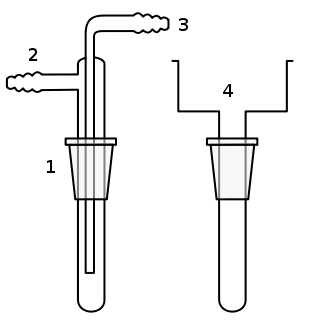
Coldfingers in the lab
You prepare your lecture bottle pretty mundanely: screw your brass fitting onto the inlet and attach whatever tubing that you prefer. I like stiff plastic tubing, but that's just an affectation more than anything. Obviously, 1/4 inch Tygon is best for good seals between tubing and fittings. If you have something that's particularly dangerous (it is, after all, a pressurized gas), you should probably clamp that thing down. While it's not pictured below, it's probably still a good diea.
- Take your coldfinger and mate it to the multi-neck round bottom of your choice. You'll note that below (3rd picture), the picture shows a three-neck flask with two septa and a needle for venting. It has been pre-weighed (with the septa and needle). Clamp the RBF and the coldfinger.
- Hook your Tygon tubing from the lecture bottle to your coldfinger.
- Cool the coldfinger to the desired temperature; in this case, -78°C.
- Slowly add the gas by opening the knob on the pre-weighed lecture bottle (slowly!) You will note that the bubbling of the coldfinger will get faster as the gas is condensing to liquid. Hopefully, the liquid is collecting on the coldfinger and you're seeing it drip into your reaction flask. Add as much as you need. You can check your progress by 1) looking 2) checking the weight of the lecture bottle or 3) checking the weight of your reaction flask (tedious). Stop when you think you're done by tightening the knob on the lecture bottle.
- You can add reaction solvent slowly by either adding it by squeeze bottle through the top inlet of the coldfinger or (for larger amounts) performing a cold cannulation. If you're experiencing clogging of the cannula (due to water (?) freezing at the tip of the cannula), you can place it deep enough into your reaction flask that it gets jarred by the stirbar.
Concerns about losing gas
When I was running these reactions, I was always concerned about losing gas. Using the "just do it" method, I think I was losing up to 30% of the gas I was trying to condense. The cold trap method dropped that significantly (<5%).
Contributors
- ChemJobber